
Malaysia Budget 2024
October 13, 2023Malaysia Service Tax rate – 6% to 8%
February 16, 2024Our Blog
E-INVOICE
In the efforts to improve business sustainability in digitization era, facilitate tax reporting and improve compliance, the Malaysia government had announced in Budget 2023 that e-Invoicing system will be implemented in Malaysia in phases and it is mandatory for all businesses.
What is e-Invoice
An e-Invoice is a digital representation of a transaction between a supplier and a buyer. e-Invoice replaces paper or electronic documents such as invoices, credit notes, and debit notes.
Just like the traditional invoice, e-Invoice also contains the same essential information such as supplier’s and buyer’s details, item description, quantity, price excluding tax, tax, and total amount, which records transaction data for daily business operations.
Benefits of e-Invoice
- Reduce manual efforts and human errors
- Facilitate efficient tax filing
- Streamline operational efficiency
- Digitalise tax and financial reporting
e-Invoice Implementation Timeline
| Annual sales turnover in 2022 (RM) | Target date for implementation |
|---|---|
| > 100 million | 1 August 2024 |
| 25 million and up to 100 million | 1 January 2025 |
| All tax payers | 1 July 2025 |
Overview of the e-Invoice Model
- Two e-Invoice models:
-
- MyInvois Portal; and
- Application Programming Interface (API),
MyInvois Portal is hosted by IRB and available to all tax payers at no cost. It is suitable for micro, small and medium-sized enterprises.
API requires upfront investment in technology and adjustments to taxpayers existing systems. It is Ideal for large taxpayers or businesses with substantial transaction volumes.
-
- Types of e-Invoices to be issued:
-
- Invoice (sample)
- Credit Note
- Debit Note
- Refund
Click here for the list of required fields for e-Invoice (source: IRB’s e-Invoice guideline version 2.0 published on 28.10.2023)
-
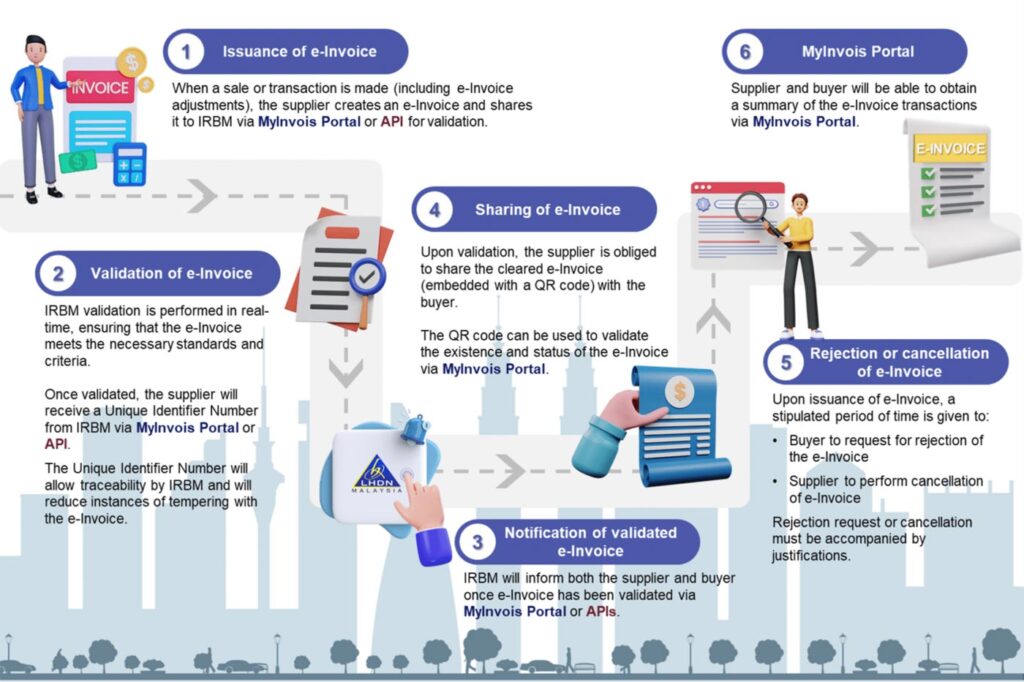
- e-Invoice workflow
Below illustrates the e-Invoice workflow from the point a sale is made or transaction is undertaken, and an e-Invoice is issued by the supplier via MyInvois Portal or API, up to the point of storing validated e-Invoices on IRBM’s database for taxpayers to view their respective historical e-Invoices.
- Preparation towards implementation of e-Invoicing system by businesses
- Set up a special team to prepare for e-Invoice implementation
- Study the e-Invoicing guidelines and attend to IRB’s training
- Assess current IT system and choose an accounting solution that is complied with the e-Invoicing requirement
- Train staff on the new e-invoicing process.
Below are the latest guidelines published by the IRB. However, the IRB’s e-Invoice guidelines may change from time to time. Please refer to the IRB’s website for the latest updates.
- e-Invoice Guideline Version 2.1 (published on 28 October 2023)
https://www.hasil.gov.my/media/iqzj1llk/irbm-e-invoice-guideline-version-21.pdf -
e-Invoice Specific Guideline Version 1.1 (published on 28 October 2023)
https://www.hasil.gov.my/media/iu1ip1x1/irbm-e-invoice-specific-guideline-version-11.pdf